May 23, 2008 : the students of Armorin present their school year project
The main issue of the class project is : “how can our consumer dietery choices impact our health, our environment as well as our social relationships ?”
Delphine Leroux-Astier
23 May 2008
The students presented the results of the research they made during the school year and the different topics they tackled.
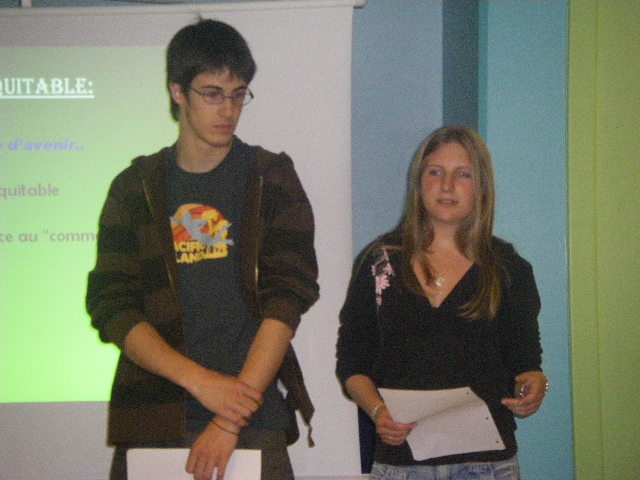
Food habits in France, the USA, and the Philippines
by Natacha and Elsa (16 yrs old)
France: traditionally rich but habits are changing. Some American influence.,
USA : marked by Germany . Americans don’t like to cook . Fatty and lots of sugar
Philippines: China, Malaysia, Indonesia, Pacific and Spain . Eat with fingers
Balanced diets : what is it? Eat a little of everything.
Philippines : poorer country so don’t always have everything they need nutritionally
Obesity
by Minnka and Aurore (16 yrs old)
Causes : heredity and meal times: gap between high intake and low expenditure
Dangers : bad for heart ; bad for bones ; respiratory problems ; sicknesses (cancer, digestive problems, infertility)
Healthy Foods : showed food pyramid ?
Sportsmen and eating habits
by Raphael T (16 yrs.)
Have special eating habits ; they eat very balanced as we should
Need sugars and fats and proteins and vitamins and salt minerals
Organic Farming
by Aline, Mindy and Candice
What is it ? Chemical-free agriculture.
Label = AB = 95% of the product is organic.
Statistics : overall it is increasing.
In France the Drome region is where most organic food is being farmed.
Pesticides
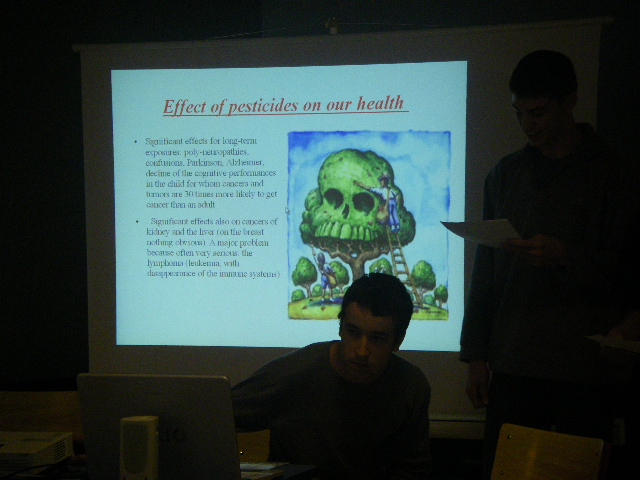
by Raphael, Thibault, Anthony (16)
Used a lot in past century and now found everywhere, and now in our bodies
One apple gets more than 25 pesticide sprays
Long-term exposure can cause health problems (parkinson’s, cancer)
GMOs: What are they?
by Jeremy and Charlie (16)
How to create them? Take dna, change it and put it in food that animals eat
History : first ones created in bacteria in the 70’s; In 80’s a big mouse the first
Who makes them ? USA control 55.3% of global production then Argentina (19%) and Brasil, Canada and China
What plants are modified ?: soy, corn, cotton, colza
GMOs in France:
Do we eat them in France?: in 2005 30 or so products sold in France, but consumers against it; 45% of animals eat GMO-modified products
What is the risk? Pollen and crops ; these pollens can bring about new diseases
Advantages : new characteristics with new resistances ;
Are GMOs the future of agriculture ?
GMOs
By Roman and Thomas
What is it? Modified DNA by removal or addition of genes
How can these be used ? Fabrication of more high-performing products ; improved harvest ; better nutritional quality ; create new medications
Ways of obtaining new varieties : traditional vs. GMO
Distorted arguments to make us say yes : increased respect for the environment; improved quality; be able to feed the world
People no longer know what to choose : GMOs or not?
Farmers are dependent on GMOs
Fair Trade: What is it?
By Etienne and Anaelle
North wants to help South to increase production and have good lifestyle
Compare price of coffee: traditional and fair trade; FT more expensive
Where did the idea come from ? In the 70s Oxfam wanted to help communities of developing countries but help them while preserving their dignity: Trade not Aid
Fair Trade is expanding today. The main product is coffee.
In 2000 only 9% of French people knew what Fair Trade is ; in 2004 = 56% ; in 2005 = 74%
The limits of Fair Trade (video in English)
By Emma, Jessica and Amandine
A good concept but it’s not perfect.
Products : sugar, honey, coffee, chocolate, fruit juice
The shops work with volunteers (ex of Artisans du Monde). Fair Trade is not so well-known.
McDonald’s and Fast Food
By Maeco, Romain and Matisse
First in Des Plaines in Illinois in 1940
Risks: obesity ; the movie “ Supersize Me” shows that fast food is dangerous.
US Secretary of health declares that obesity is a national epidemic.
Today, 421 brands of fast food and 23 big chains
Fast food is everywhere; two countries don’t have mcdos : Nepal and Rwanda
In Manhattan : 104 McDonald’s.
143 times more money budgeted for fast food commercials than for fruits and vegetables
Food and advertising
by Manon and Lindsay
75% of advertisements are for fatty or sugary foods
|
| | The views and opinions expressed on this website in content created or written by persons other than those who work for Monde Pluriel, do not necessarily represent those held by Monde Pluriel. |
|


